

Perceptual Robotics closes $2.1M funding round

Perceptual Robotics is excited to announce its latest funding round led by TSP Ventures, an early stage Venture Capital Fund supporting exceptional businesses focusing on climate and environmental technologies. The round is joined by Humble Holdings, an impact investments firm, existing investors Metavallon VC and other strategic angel investors. The company has raised a total of $3.6M so far (Crunchbase).

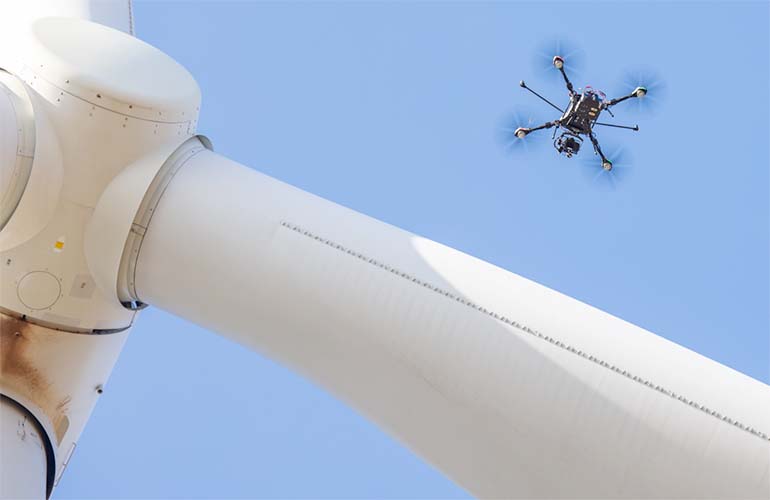
Perceptual Robotics uses drones, advanced robotics and machine learning to provide fully autonomous inspections of infrastructure, starting with wind turbines. These inspections identify and analyze defects with greater consistency, greater reliability and reduced costs when compared to current methods. The company has been developing their hardware and software capabilities since 2016 when it was founded at the Bristol Robotics Laboratory, while today it also operates from its Athens office. Perceptual Robotics are now carrying out autonomous inspections for some of the largest wind turbine operators in the world.

Chris Smith, CEO at TSP Ventures said, “we are delighted to be joining the team at Perceptual Robotics. Their mission, to reduce costs and improve efficiencies in the wind turbine inspection market, is helping the whole of the wind industry become more efficient and cost effective. At TSP, we love enabling technologies that can help accelerate the transition to renewable energy and a cleaner future for our planet. We look forward to supporting Kostas and the rest of the team as they scale operations internationally.”

Kostas Karachalios, CEO of Perceptual Robotics said, “we are delighted to have raised our latest round, led by TSP Ventures. We have had growing revenues and this new funding will allow us to increase headcount, continue to mature our groundbreaking technology and drive the scale of our sales and marketing activities on the back of our recent successful programmes with clients across Europe. We are fortunate to have been supported in our early funding rounds by Metavallon and with the addition of TSP, Humble Ventures and Angels with deep sector knowledge, we feel we have a very strong investor-base who complement each other well. We are growing our team with system engineers and sales engineers and are looking for exceptional people to join us in Athens and Bristol. We are in a good position to provide excellent services to our clients and new automations for the wind and other industries. The future is both bright and exciting”.

Source: https://www.therobotreport.com/perceptual-robotics-closes-2-1m-funding-round/


New AI tool accelerates discovery of truly new materials

Reported in the journal Nature Communications, the new tool has already led to the discovery of four new materials including a new family of solid state materials that conduct lithium. Such solid electrolytes will be key to the development of solid state batteries offering longer range and increased safety for electric vehicles. Further promising materials are in development.

The tool brings together artificial intelligence with human knowledge to prioritise those parts of unexplored chemical space where new functional materials are most likely to be found.

Discovering new functional materials is a high-risk, complex and often long journey as there is an infinite space of possible materials accessible by combining all of the elements in the periodic table, and it is not known where new materials exist.

The new AI tool was developed by a team of researchers from the University of Liverpool’s Department of Chemistry and Materials Innovation Factory, led by Professor Matt Rosseinsky, to address this challenge.

The tool examines the relationships between known materials at a scale unachievable by humans. These relationships are used to identify and numerically rank combinations of elements that are likely to form new materials. The rankings are used by scientists to guide exploration of the large unknown chemical space in a targeted way, making experimental investigation far more efficient. Those scientists make the final decisions, informed by the different perspective offered by the AI.

Lead author of the paper Professor Matt Rosseinsky said: “To date, a common and powerful approach has been to design new materials by close analogy with existing ones, but this often leads to materials that are similar to ones we already have.

“We therefore need new tools that reduce the time and effort required to discover truly new materials, such as the one developed here that combines artificial intelligence and human intelligence to get the best of both.

“This collaborative approach combines the ability of computers to look at the relationships between several hundred thousand known materials, a scale unattainable for humans, and the expert knowledge and critical thinking of human researchers that leads to creative advances.

“This tool is an example of one of many collaborative artificial intelligence approaches likely to benefit scientists in the future.”

Society’s capacity to solve global challenges such as energy and sustainability is constrained by our capability to design and make materials with targeted functions, such as better solar absorbers making better solar panels or superior battery materials making longer range electric cars, or replacing existing materials by using less toxic or scarce elements.

These new materials create societal benefit by driving new technologies to tackle global challenges, and they also reveal new scientific phenomena and understanding. All modern portable electronics are enabled by the materials in lithium ion batteries, which were developed in the 1980s, which emphasises how just one materials class can transform how we live: defining accelerated routes to new materials will open currently unimaginable technological possibilities for our future.

Story Source:

Materials provided by University of Liverpool. Note: Content may be edited for style and length.